
What a Professional Classic Car Restorer Actually Does
January 2, 2026
Most people think a classic car restorer is someone who fixes old cars, and that assumption is where a lot of restoration projects start going sideways.
A professional classic car restorer is not defined by how well they weld, paint, or fabricate in isolation. The role is about judgment. Knowing what to touch, what to leave alone, what must be corrected now, and what will cause failure later if ignored. At Auto Art, restoration work is built around decision-making discipline as much as the physical labor itself .
The work is methodical, often slow, and rarely flashy. It is closer to problem-solving than artistry, even though good restoration often looks beautiful when finished.
Below is what a professional classic car restorer actually does, beyond the surface-level assumptions.
- A Professional Classic Car Restorer Starts With Evaluation and Refusal
- Disassembly Is a Controlled Process Not a Tear Down
- A Professional Restorer Prioritizes Structure Over Cosmetics
- Metalwork Is About Control Not Speed
- Body Fitment Is Revisited Repeatedly
- Paint Decisions Are Strategic Not Cosmetic
- Managing Scope Changes Is a Core Responsibility
- What a Professional Classic Car Restorer Will Not Do
A Professional Classic Car Restorer Starts With Evaluation and Refusal
The most important work happens before the first bolt is removed. A professional classic car restorer evaluates the car that exists, not what they hope is there. This includes inspecting known rust areas, measuring structural alignment, identifying previous repairs, and determining whether the car can realistically meet the owner’s expectations and budget.
This stage often reveals problems that are uncomfortable to discuss. That is the point.
Evaluation is not about producing a perfect estimate, it is about defining risk. Cars that have been repainted multiple times, patched with filler, or repaired without documentation will carry hidden liabilities. A professional restorer identifies those liabilities early and explains the consequences of ignoring them.
Refusal is part of this process. Some cars are not good candidates for full restoration. Some budgets cannot support the level of work required. A professional restorer says no when alignment between car, scope, and expectations does not exist. That refusal protects everyone involved.
Disassembly Is a Controlled Process Not a Tear Down
Taking a car apart without documentation is not restoration.
Once a project is accepted, a professional classic car restorer manages disassembly as a controlled, documented process. Components are cataloged, fasteners labeled, shim locations recorded, and reference photos taken continuously. Factory inconsistencies are noted rather than “corrected” arbitrarily.
Older vehicles were assembled by hand. Panel gaps varied. Seams were not always symmetrical. A professional restorer understands that originality often includes imperfection. Preserving or correcting those details requires knowing how the car was built, not just how it looks when finished.
Disassembly can take weeks on complex projects. That time is an investment. Lost information during teardown cannot be recreated later.
A Professional Restorer Prioritizes Structure Over Cosmetics
If the structure is wrong, everything built on top of it will be wrong.
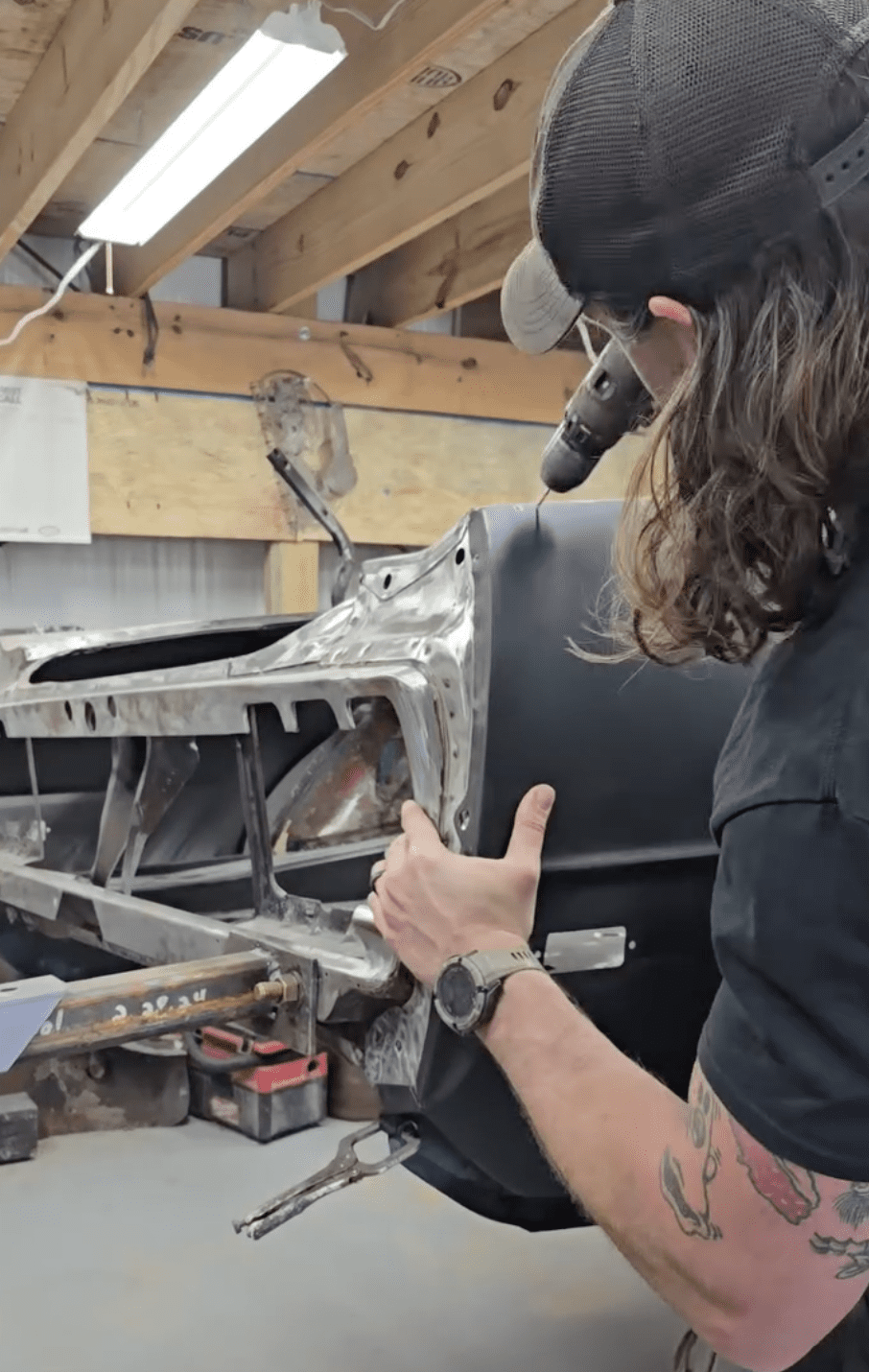
One of the clearest differences between a professional classic car restorer and a general body technician is prioritization. Structure comes first. Frames are inspected. Mounting points are checked. Floors, rockers, and structural seams are evaluated for integrity, not appearance.
At Auto Art, metalwork includes rust cut-out, steel replacement, and hand-fabricated panels when parts are no longer available . These repairs restore strength and geometry, not just visual smoothness. Burying rust or relying on filler to create shape is just deferred failure.
A professional restorer also understands when replacement panels introduce new problems. Poorly stamped aftermarket parts often require extensive modification to fit correctly. Choosing repair over replacement is sometimes the more difficult and time-consuming option, but it preserves fit and structure long term.
Metalwork Is About Control Not Speed
Welding and fabrication are only part of what a classic car restorer does in metalwork. The real skill lies in controlling heat, sequence, and distortion. Panels are stitched, cooled, and worked gradually. Seams are aligned with original construction methods when possible.
Leaded seams, spot weld replication, and correct flange geometry matter on high-quality restorations. These details affect how panels sit, how they age, and how they respond to vibration.
A professional restorer works with those realities instead of fighting them.
This is slow work. Anyone promising fast metal repair on a severely rusted car is either inexperienced or dishonest.
Body Fitment Is Revisited Repeatedly
Body fitment is not a single phase. Doors, fenders, hoods, and decklids are installed, adjusted, removed, and reinstalled multiple times throughout a project. A professional classic car restorer understands that metalwork, primer build, and paint thickness all affect final alignment
Panels are fit in relation to each other, not in isolation. Door gaps dictate fender placement. Weatherstripping compression is considered before final adjustments. A restorer who chases symmetry without context usually creates tension that shows up later as chipped paint or stress cracks.
Filler is used sparingly. Its purpose is refinement, not correction.
Paint Decisions Are Strategic Not Cosmetic
A professional restorer chooses paint systems based on consequences.
Paint is where many people assume the restorer’s job ends. In reality, paint is the result of dozens of decisions made earlier. A professional classic car restorer selects paint systems based on originality goals, vehicle use, and long-term durability.
Auto Art applies both single-stage and basecoat-clearcoat systems depending on the project, with attention to material compatibility and proper cure times .
- Single-stage finishes may be more period-correct but require different maintenance.
- Basecoat-clearcoat systems offer durability but can alter original appearance.
Neither choice is universally correct. The restorer’s role is to explain those tradeoffs clearly and execute the chosen system correctly.
Managing Scope Changes Is a Core Responsibility
Restoration always reveals more than expected. Hidden rust, old collision damage, and poor prior repairs are common discoveries once a car is stripped. A professional classic car restorer does not ignore these issues or push through quietly. They stop, document the problem, explain options, and obtain approval before continuing.
This process protects trust. Change orders are not failures, they are acknowledgments of reality. What matters is how they are handled.
A restorer who avoids hard conversations early creates much harder ones later.
What a Professional Classic Car Restorer Will Not Do
Professional restorers refuse to hide rust to meet deadlines, they do not guess at originality when documentation exists. Nor do they promise timelines that ignore discovery work. Professional car restorers do not accept scopes that conflict with structural integrity or long-term durability
At Auto Art, mechanical and interior work are coordinated with specialized vendors rather than performed in-house, because focus and specialization matter . These boundaries exist to protect quality.
A restorer who agrees to everything is not flexible. They are avoiding responsibility.
Your Next Steps
A professional classic car restorer is not just someone who works on old cars. They are someone who manages risk, preserves structure, and makes difficult decisions early so the finished car does not fail later. If you want an honest evaluation of your car and a clear discussion about what level of restoration makes sense, Contact us.
FAQ
A professional classic car restorer evaluates, disassembles, repairs structure and metalwork, manages fitment and paint preparation, and controls scope to protect long-term outcomes.
No. A restorer focuses on structure, originality, documentation, and long-term durability, not just cosmetic repair.
Because proper evaluation, metalwork, and fitment are slow processes and rushing them leads to failure later.
Generally no. Classic car restoration requires a set of specialized skills that normal body and collision shops simply do not have.
Follow us
Hours
BLOG
Address: Marion, KY
Email: Cecil@autoartrestoration.com
Phone: 270.704.7444
Quick Links
